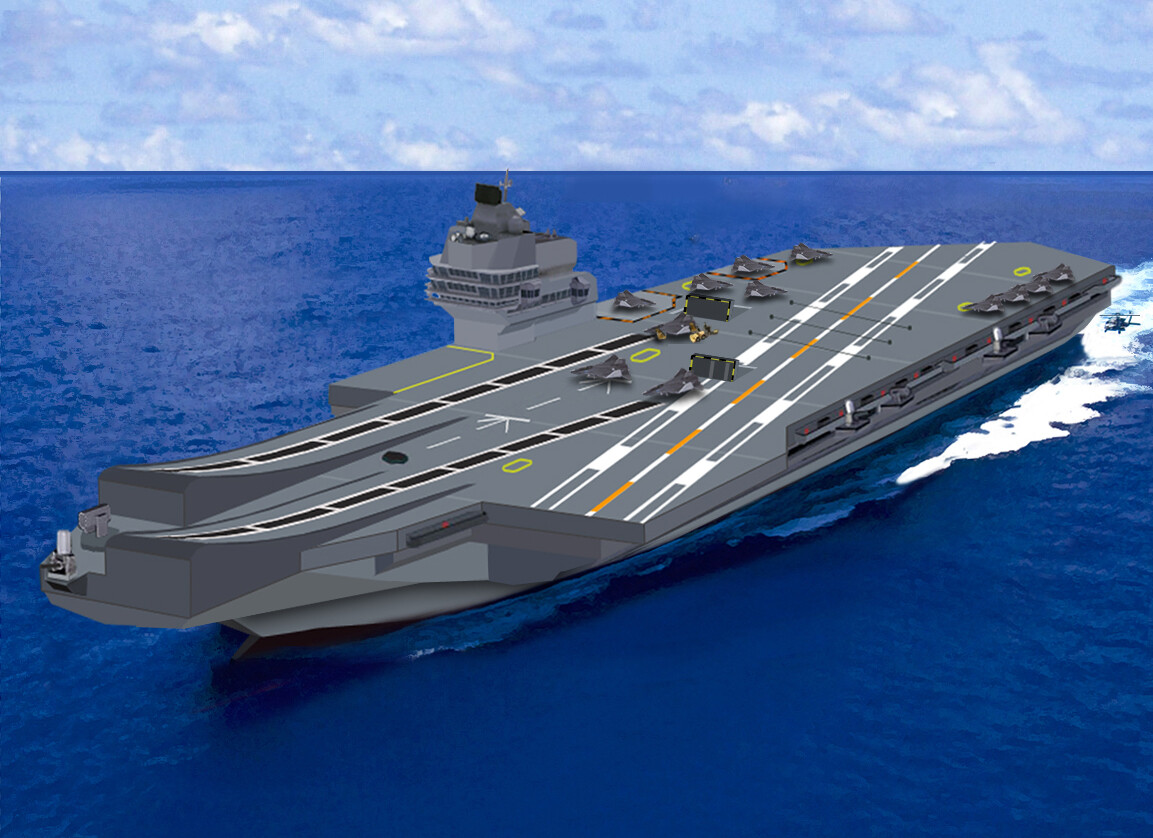
Future Medium Sized Aircraft Carrier Concept with F35s and Sea Gripens
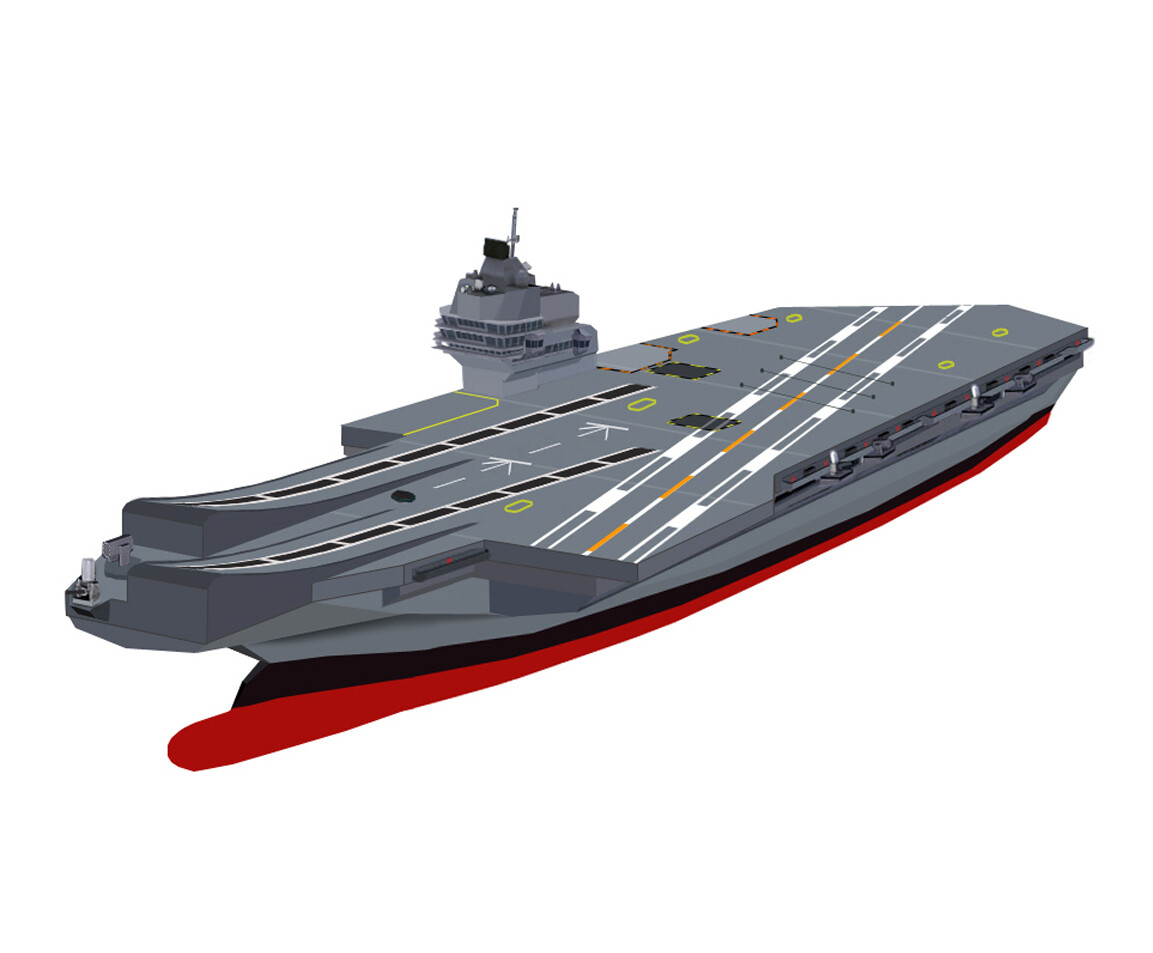
Future Medium Sized Aircraft Carrier Concept with F35s and Sea Gripens
Aircraft carriers are useful tools for any maritime nation, but only a handful of nations can also afford buying and then properly operate them. Although the list of countries possessing aircraft carriers is around a dozen, only the US, UK, France and China seem to be able to both design, build and operate carriers with a sufficient complement of aircraft and trained crew. Even Russia, which on paper possesses a good aircraft carrier, saw poor performance of its Admiral Kuznetsov aircraft carrier during the Syrian campaign, stressing the importance of not just being able to build, or buy a carrier, but also train its crew and the pilots properly and keep the aircraft and the ship in good condition.
So it's no surprise that nations with a modest defence budget, or a smaller GDP than the US, UK, France and China, either operate smaller aircraft carriers (India), or use helicopter carriers or amphibious assault ships with flight decks, to operate a small number of sea going fighter jets when needed (i.e. Japan, South Korea, Italy and Spain).
Yet, how useful such ships may be for today's world, they aren't dedicated aircraft carriers and lack the facilities and the assets to deploy aircraft in larger numbers that may be needed in the near future. So in the end, countries like Japan, South Korea and also countries currently without carriers who could use them (Brazil, Australia, Canada), may need to buy dedicated aircraft carriers with a capability to carry at least around 25-40 (fixed wing and rotary) aircraft.
In order to minimize the costs, for these countries it may be interesting to cooperate in designing, developing, testing and building a common aircraft carrier design that can be adapted and equipped to each country's needs and budget.
This design could be such a commonly developed and built aircraft carrier. It can have a length of in between 252 and 268 metres (depending on the available budget and needs of each nation), with a displacement in between 48,000 - 62,000 tons when fully loaded, is conventionally powered and, in the largest version (length of 268 metres, width of 72 metres and 62,000 tons displacement), can carry up to 40 fixed wing- and rotary aircraft (24-26 jet fighters, 4 AEW aircraft, 2 COD aircraft and 6-10 helicopters).
In order to save costs, the flight deck has a STOBAR ( ("Short Take-Off But Arrested Recovery" or "Short Take-Off, Barrier Arrested Recovery") configuration, with aircraft launching under their own power using a ski-jump to assist take-off (rather than using a catapult), but require arrestor wires to land on the ship (unlike STOVL aircraft, like the F35B). There are currently good aircraft available for STOBAR carriers: the F35B, the MiG-29K, the J-15 (based on the Russian Su-33) and India's Tejas are all suited for STOBAR operations, while Boeing claims its F-18E/F could be operated from a STOBAR flight deck as well. And an interesting candidate for such a carrier is the Swedish Gripen. Swedish manufacturer SAAB has proposed a sea going version based on the latest JAS-39 Gripen E (or Gripen Next Generation - NG). The current Gripen-E would require little adaption (according to SAAB) and would provide buyers a state of art aircraft with excellent flying characteristics, pilot interface and 5th generation avionics to give pilots and commanders on the ground, optimal situational awareness with advanced data fusion and artificial intelligence in its software. It is also equipped with an AESA-radar with around 1,000 Gallium Nitride T/R-modules. And it can fire the MBDA Meteor BVR air-to-air missile. In all, a Sea Gripen would give any Navy a formidable 4.95-Generation aircraft with almost the same situational awareness that the F35 offers, but most likely for USD 30 mln per unit less then when buying the F35B (which comes with a unit price of around USD 115 mln when buying 25).
To add even more capability to a carrier flying the Sea Gripen or the F35B on this STOBAR carrier, it could use the EV-22, the airborne early warning (AEW) version of the V-22 Osprey tilt-rotor aircraft as an AEW platform.