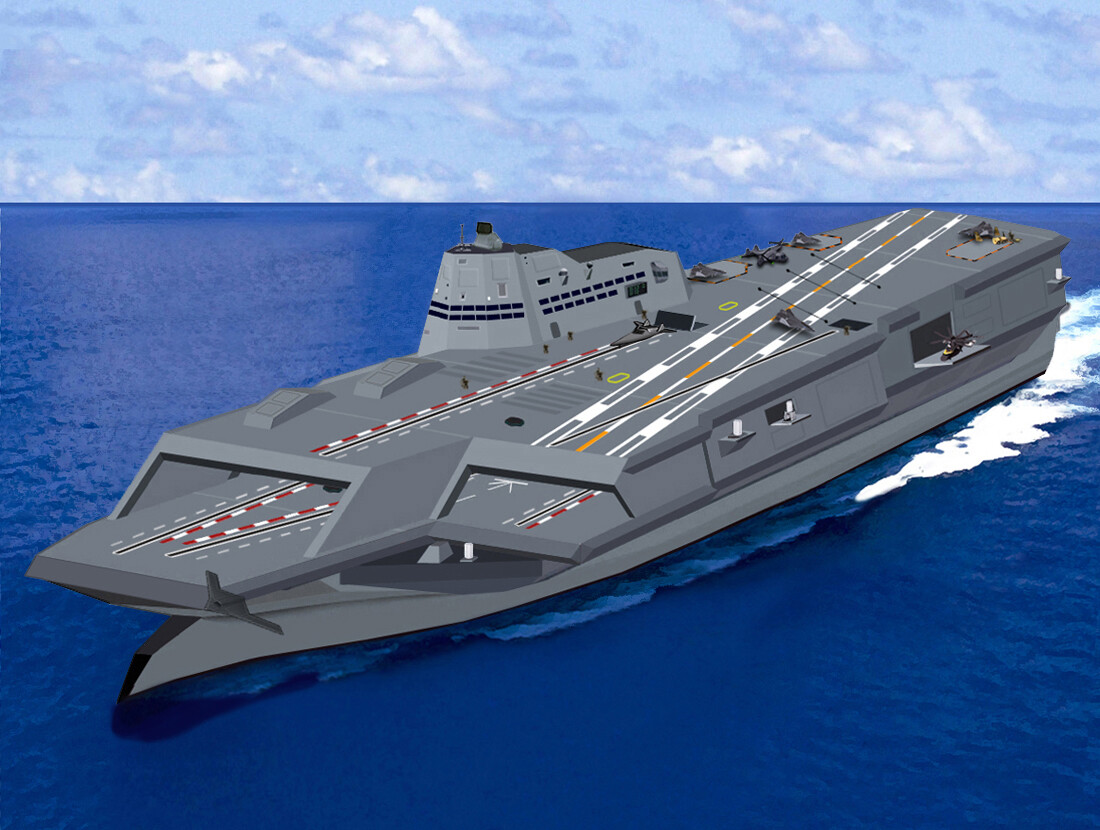
With the advent of ever more capable and relatively cheap to produce and operate UAVs, UCAVs and new ultra-quiet submarines, as well as new long range cruise- and anti-ship missiles, and with Russia and China both developing long range hypersonic missiles specifically designed to take out aircraft carriers, is there a case to be made for a Zumwalt-like stealth aircraft carrier in the future?
Stealth isn't a magic tool that can make items invisible, but a set of measures taken to reduce the chance to get detected by adversaries. Submarines are the most stealthy warships in service. Since the last two decades, much has been done to make surface vessels more stealthy as well. Most of these measures focus on reducing the radar signature of a vessel, which is dictated by 5 factors:
- Aspect
- Shape
- Size
- Material
- Texture
The factors above have been optimized for a stealth warship for the first time by the US Navy with their latest Zumwalt-class destroyers. Though these destroyers have a length of 192 metres and a displacement of over 15,000 long tons, they are approximately 50 times harder to detect than the smaller destroyer class it replaces. However, the costs for the Zumwalt are enormous: just one unit comes with a price of over USD 4 billion and still, the ship is plagued by issues that haven't been resolved yet. It's one of the reasons the US Navy had to cut down the order from the originally planned 8 to 12 units, to just 3.
Nonetheless, future developments could force Navy planners to design and construct stealth (or more stealthy) Zumwalt-like aircraft carriers, in order to keep aircraft carriers relevant in the future. Expected costs for such vessel could be gigantic and even the United States can't afford to purchase such multi-billion dollar warships in large numbers. So perhaps in order to reduce costs, the US could team up with the UK, France, Australia, South Korea and Japan to jointly develop such a stealth carrier in a similar way it has developed the JSF (Joint Strike Fighter aka F-35 Lightning II). All these countries could co-operate to design and construct a basic model for a stealth carrier, with each partner country to equip and arm the carrier to its own needs.
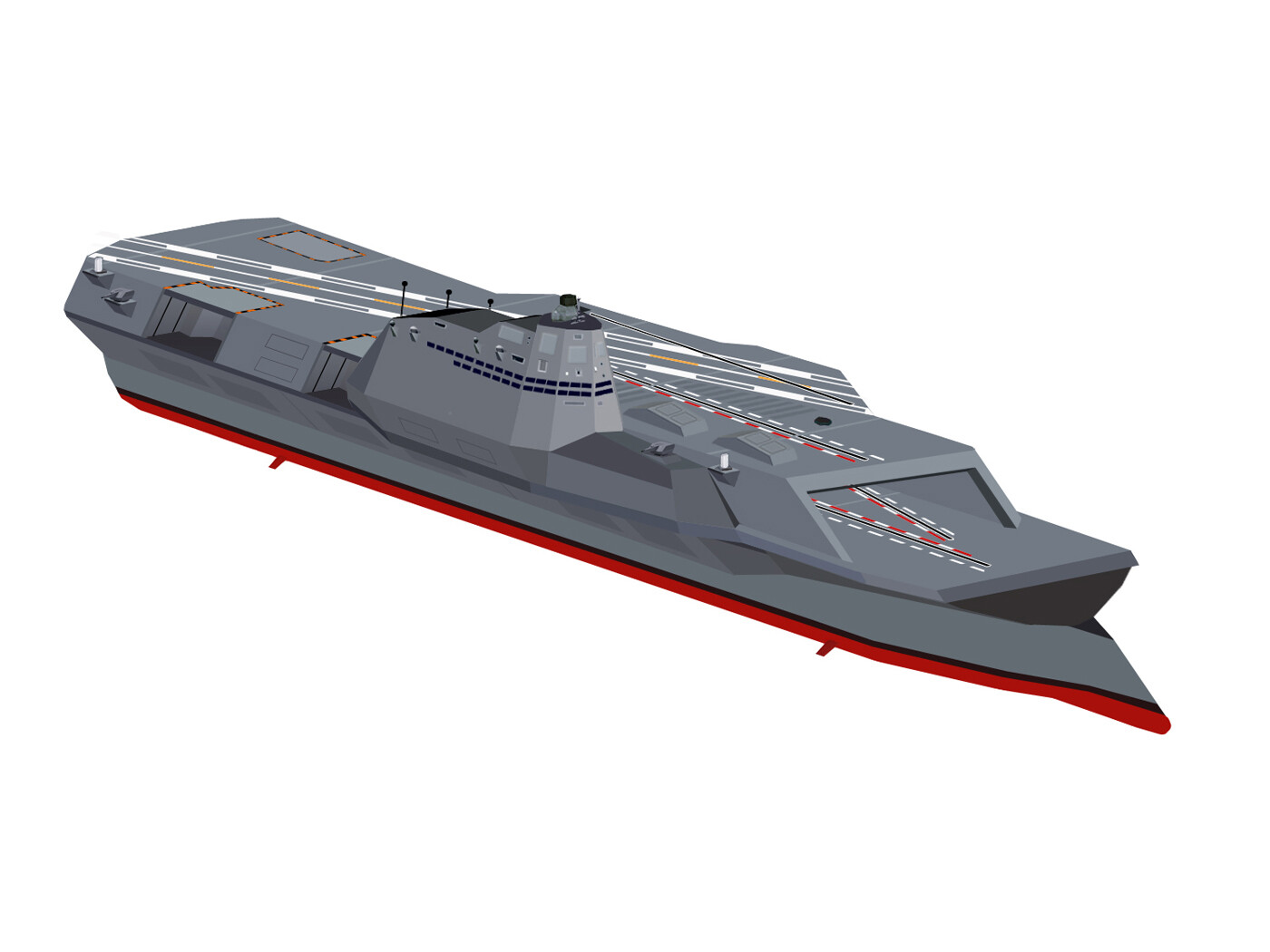
The model shown here, has a length of 302 metres, a max beam of 78 metres and a displacement (when fully loaded) of around 82,000 tons. It has two flight decks in a CATOBAR configuration, using the US electromagnetic (EMALS) launch system to launch aircraft. The lower flight deck can be used to launch and store UCAVs and manned aircraft, while the exposed upper flight deck can be used as an extra deck if necessary, to launch manned aircraft. Aircraft can only land on the angled landing strip on the upper deck, which has retractable designed arresting gear only exposed when aircraft have to land on the carrier, in order to minimize radar reflection when no aircraft need to be recovered.
The airwing would carry a mix of up to 120 5th and 6th generation (rotary- and fixed wing) aircraft and UCAVs (Unmanned Combat Aerial Vehicles). It would also have laser weapons, stored in stealthy weapon pods for close in self defense. The ship would be highly automated, reducing the crew needed to operate the ship to around 450. It could be nuclear powered, as well as conventionally powered and when nuclear powered, has a top speed of +30 kts, with an almost unlimited range. The ship needs to be build using both steel (covered with radar absorbent paint and other radar absorbent material for the parts above the waterline) and as much composites (such as carbon-fiber, fiberglass and plastic) as possible for the non-steel parts. The used material combined with the aircraft carrier's angular build makes it around 50 times harder to spot on radar than a modern day aircraft carrier of similar size and displacement, while the acoustic signature is comparable to that of the Los Angeles-class submarine.