Future Tank Concept
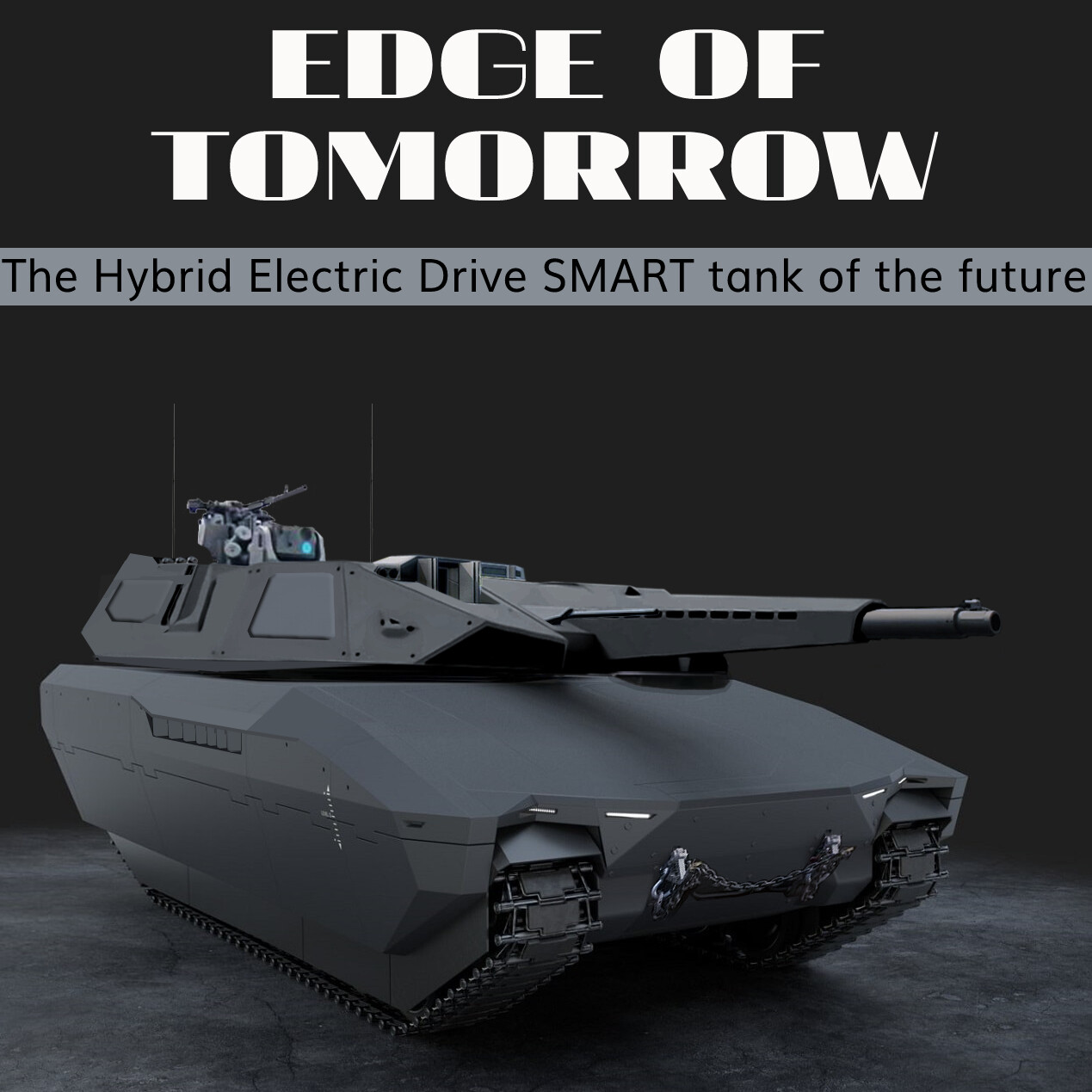
My concept of a future tank has a chassis based on the Polish PL 01 stealth tank concept, a turret based on Germany’s latest Panther KF51 and concepts that have been offered by various Israeli companies to the IDF as the successor of its Merkava MBT.
Armament
Main armament is the Rheinmetall Future Gun System (FGS), which consists of a 130 mm smoothbore gun and a fully automatic ammunition handling system. The autoloader holds 20 ready rounds. Compared to current 120 mm systems, the FGS delivers over fifty percent greater effectiveness at significantly longer ranges of engagement. The FGS can fire kinetic energy (KE) rounds as well as programmable airburst ammunition and corresponding practice rounds. In addition to these munitions, the tank’s 130mm gun can accommodate special munitions for long-range strikes and against multiple targets
The FGS’ 130 mm smoothbore gun could be replaced in the future by a hypervelocity gun (also known as a 'railgun') when technology advances enable such a system (which is not expected in the coming 20 years). Secondary armament includes a 12.7 mm coaxial machine gun and a fully automated Remote Controlled Weapon Station with a 7.62mm machine gun. Optional loitering ammunition capability expands the tank's strike capability to non-line-of-sight targets at a distance of up to 40 km from the tank.
When configured as an infantry support vehicle (for example in urban environments) the optional internal 90mm automated Remote Controlled Mortar System (that can be fitted in specially designed sections of the turret) to target positions that its main gun can’t fire at due to the elevation limits of the gun.
Next-Generation Propulsion System
The tank is powered by a hybrid electric drive, that includes the following elements:
Internal Combustion Engine (diesel engine), motor-generator (AC induction motor(s) with squirrel-cage rotor), two traction electric motors on the left and right side, energy storage buffer (ESB) made on the basis of consecutively connected lithium–sulfur batteries and
power electronics units. For the use on a combat tracked platform, the most appropriate variant is hybrid electric drive with consecutively connected elements (no rigid kinematic connection) and ESB on board. The main advantage of an ESB is to enable compensation for the difference between mean and maximum power of the electric drive system, which is required for movement and acceleration of the combat tracked platform accordingly.
SMART technology
Drawing on the latest technologies, next-gen features including automation, robotized support, sensor-fusing, multi-domain connectivity and data-sharing in a Combat Cloud environment, and AI (Artificial Intelligence) decision support have paved the way for an unmanned turret and Human-Machine Teaming, enabling a reduction in crew size to
just two, though the tank is fitted with a total of four workstations for additional crew members when mission profiles (such as infantry support in urban areas) require such.
Other innovative features
Reconnaissance quadcopters can be launched from the turret, allowing the tank to conduct its own local reconnaissance. The quadcopter drones also have an active defense capability against enemy drones.
Survivability
The tank’s survivability is based on a fully integrated, comprehensive, weight-optimized protection concept that uses active, reactive, and passive armor to protect against a wide gamut of threats, including enemy tanks, anti-tank weapons, improvised explosive devices (IEDs), and mines.
To counter anti-tank weapons, especially ones that can strike from above—like the FGM-148 Javelin anti-tank missile that has been wreaking havoc on Russian tanks in Ukraine—Rheinmetall AG has designed the Top Attack Protection System (TAPS). In addition, the ROSY smoke/obscurant system can quickly conceal the KF-51 Panther from enemy observation.
Because the tank leans more heavily on lighter active and reactive defenses than heavier passive defenses, the overall weight of the vehicle can be reduced to around 52 tons in its basic configuration. Modular steel composite armor plates and reactive tiles can be added when the mission profile of the tank requires that.
The tank is also designed to operate in a contested electromagnetic environment, making it fully hardened against cyber threats.