2035 - India's future supercarrier INS Gandhi on patrol in the Indian Ocean
In today's fast changing geopolitical landscape, India may be the best hope for the West to counter China's rise from a local military power to the global military superpower China aspires to be.
China's enormous industrial and economic infrastructure is already working on full power to extend the military capabilities of China's armed forces to far beyond its own territory. And China has several good reasons to do so:
First, China is still heavily dependent on the import of oil and gas from countries such as Indonesia and the Persian Gulf states. So it needs a strong military with off shore fighting capabilities in order to protect these precious supply lines with these countries.
China also needs a strong military with capabilities to project her power far beyond its own borders in order to secure and protect its massive, multi-trillion dollar global infrastructure project known as 'The Belt and Road Initiative'.
Yet, China's ambitions can bring it on a collision course with both the West, as well as other nations, such as India. Much of China's The Belt and Road Initiative-project involves nations with ports to the Indian Ocean. China has already seized full control of a port in Sri Lanka and is working on a network of military ports and facilities in the Indian Ocean. Which can pose a serious threat to both the security and interests of Western nations, as well as India. The latter is the second largest country in Asia and (in population) in the world and has a 7516.6 km long coastline along the Indian Ocean.
Furthermore, China is becoming a strong ally of India's arch enemy, Pakistan. And Chinese and Indian troops have already clashed several times along the Sino-Indian border. And although a full scale war between both Asian giants is unlikely (and not in the interest of any of the two countries), military confrontations of some kind between both armed forces, aren't unlikely in the near future.
India may need to seriously increase her military capability if it wants to counter China's military power in a future conflict. One important asset that could help the Indian armed forces in a future conflict with China, could be a new supercarrier with a state-of-the-art air wing.
At present, India operates one aircraft carrier, INS Vikramaditya (with the MiG-29K as its primary naval combat aircraft), while the second, INS Vikrant, is under construction in Cochin, due for commissioning in 2022. Both vessels have a displacement — the measure of a vessel’s weight — of 45,000 tonnes each. Furthermore, India is planning to develop a third aircraft carrier - INS Vishaal by 2030. Though India's two aircraft carriers INS Vikramaditya and INS Vikrant provide the country with powerful maritime assets in a theatre where no other direct competitors have aircraft carriers, these vessels come short in naval air power capabilities compared to for example, US supercarriers and the French and British aircraft carriers and will also come short compared to China's planned supercarriers.
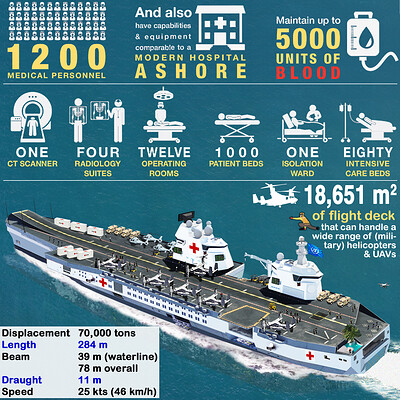
This design features a 82,000-ton conventionally propelled, domestically produced CATOBAR (Catapult Assisted Take-Off But Arrested Recovery) carrier, including the EMALS electromagnetic catapult system used on the Gerald R Ford class. It has a length of 308 metres, a beam of 80 metres and it has a range of 10,000 nautical miles without the need to refuel. In order to save on development costs, she's based on the blueprints of the British HMS Queen Elizabeth Class carriers, though the position of the two islands is different from the QE-class layout. The island for ship control functions is placed further to the front of the ship, while the FLYCO island is placed further aft, to furthermore increase the space for flight-deck operations and aircraft maintenance, thus enabling the ship and air wing to launch more aircraft sorties per day.
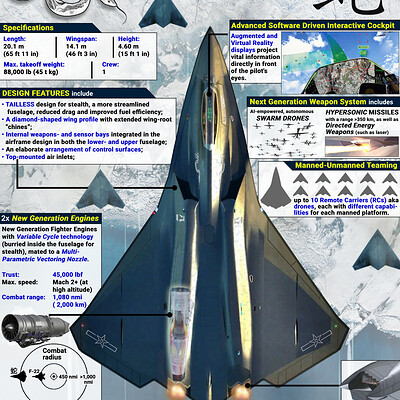
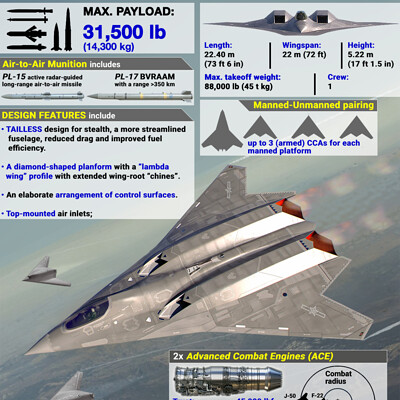
She can carry up to 82 aircraft, with a maximum capacity of 48 manned jet fighters. These include a mix of French built Dassault Rafale-M(arine) F4's (India already operates landbased Rafales) and the Franco-German FCAS(Future Combat Air System), or the BAE Systems Tempest (the UK's planned 6th gen aircraft), as well as early warning planes such as the E-2D Hawkeye. She will also be deployed with a number of UAVs/UCAVs.
The future Indian supercarrier will enter service in 2038 and will carry the name of the country's legendary founder: Gandhi.