Concept for Australia's future aircraft carrier HMAS Melbourne
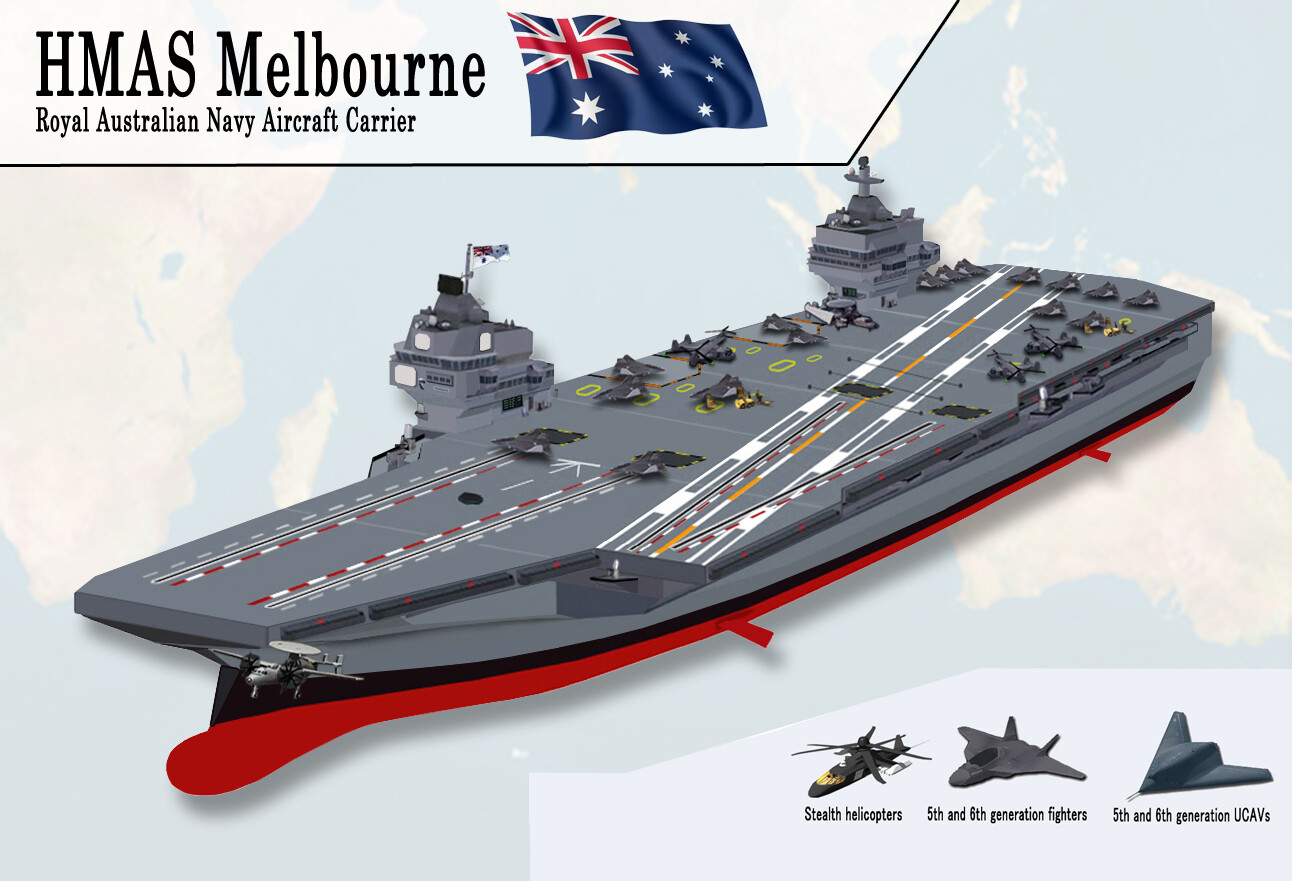
On display is a concept I made of a conventional powered supercarrier for the Royal Australian Navy (RAN). Australia is one of the closest and most loyal allies to the United States and may soon find itself in need of a new, state of the art super carrier, to help the US counter the rise of China's maritime power in the Indo-Pacific region. A new supercarrier can also give Australia a powerful asset it could deploy to assist the US, in the event of a Chinese invasion of Taiwan. And it could help secure Australia's maritime interests in the Indo-Pacific region, which may very well be the next theatre of a major conflict in the future.
My design for the RAN is largely based on the Royal Navy's HMS Queen Elizabeth Class aircraft carriers, but with some distinctive differences:
First of all, it's a larger warship: it has a length of 318m, an overall beam of 82m and a displacement of around 92,000 tonnes. It carries 62 fixed wing- and rotary aircraft, including 48 manned combat jets (upto 84 aircraft carried at surge capacity). A number of UAVs/UCAVs can also be added to the manned aircraft deployed.
Design
Like the QE-class, this vessel has 2 smaller islands instead of a traditional single island. The forward island is for ship control functions and the aft (FLYCO) island is for flying control.
However, the position of the two islands is different from the QE-class layout. The island for ship control functions is placed further to the front of the ship, while the FLYCO island is placed further aft, to furthermore increase the space for flight-deck operations and aircraft maintenance, thus enabling the ship and air wing to launch more aircraft sorties per day.
Aircraft
The most noticeable difference is the flight deck configuration itself: while the QE-class can currently only operate STOVL aircraft, this supercarrier has a CATOBAR configuration, which allows it to launch jets using an electromagnetic launch system and recover these jets using an arrestor gear. This allows the RAN to deploy a wider variety of (combat) jets, such as the F-18E/F Super Hornet (which it already is familiar with), F-35C (Australia is already a large customer of the F-435A) and the E-2D Hawkeye for AWACS (and it could also receive CATOBAR jetfighters from allies, such as the French Rafale-M). That is a significant advantage over the aircraft types that can be deployed on the QE-class.
Propulsion
Though nuclear propulsion has some major advantages over the use of conventional power, the first also comes with huge cost. Besides that, so far only the US has been able to successfully field reliable, powerful nuclear reactors and subsystems for its aircraft carrier fleet. The French aircraft carrier Charles de Gaulle, the only non-US nuclear powered aircraft carrier in the world, has suffered from severe technical difficulties and huge cost overruns with its own nuclear power plant and has been docked far more often because of that. Even China, which is investing unlimited resources in expanding its military capabilities, seems to have abandoned building nuclear powered supercarriers (at least for now) due to the difficulties and high costs in the development of safe, reliable and powerful reactors and subsystems.
And since the US has banned the sale of its advanced nuclear technology to other countries (including its closest allies), an advanced conventional power system similar to the one on board the QE-class carriers, is the only serious option for this supercarrier.
Other features
The ship is highly automated, reducing the crew needed to operate the ship to around 450, creating more room to each crew member, as well as more space to carry extra fuel, weapons, payload and aircraft. The ship also houses cyberwarfare rooms with some of the worlds most powerful servers on board.
Arnement: the HMAS Melbourne has a mix of AAA-, laser weapons and A2A-missiles for defence against incoming arial- and sea targets.
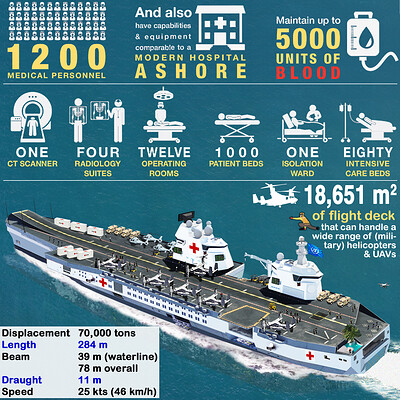
Dister relief: She will have a fully equipped hospital deck too, with 200 permanent beds, several critical care units and a infectious disease ward, so she can also function as a disaster relief ship.
Transport: And she can carry upto 450 Marine Commandos for amphibious operations, or to support special operations, counter terrorism and counter piracy missions.